

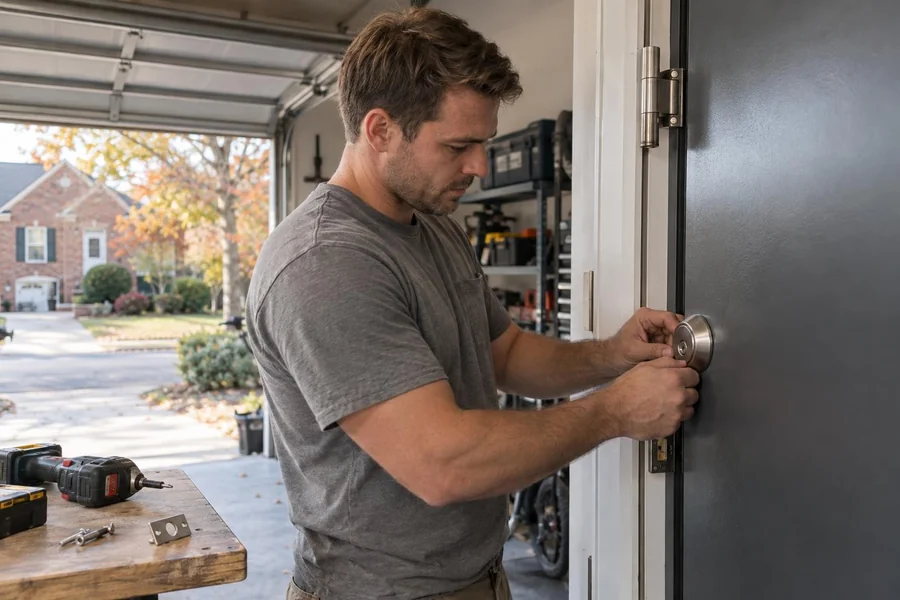
Ask a Charlotte homeowner to list their exterior doors and they will name the front door, the back door and maybe the slider to the deck. Almost nobody names the door between the garage and the kitchen, and that omission is exactly why it is the door that fails. It is treated as an interior door because it is under the same roof, fitted with a cheap passage knob or a builder-grade lock, left unlocked because the garage door “is closed anyway,” and forgotten when the rest of the house is rekeyed.
From the outside, the logic runs the other way. A garage door is the largest and often the least secure opening on the house, a side door into the garage frequently has the worst lock on the property, and once someone is inside the garage they are out of sight of the street with time and tools around them. The door into the house is the last line, and it needs to be built like one.
What the code already expects of this door
Building codes treat the door between an attached garage and the living space as a fire separation. In most jurisdictions, including those following the North Carolina residential code, it must be a solid wood door of a minimum thickness, a solid or honeycomb-core steel door, or a door carrying a fire rating, and it must be equipped with a self-closing device so it does not stand open. The purpose is to slow a garage fire, which is where cars, fuel and chemicals live, from reaching the bedrooms.
That requirement happens to produce a door that is also strong against forced entry, if the hardware matches it. A solid door with a hollow-core lock is a wasted door.
The hardware the door should carry
- A proper deadbolt, Grade 2 or better, with a one-inch throw, not just a keyed knob
- A reinforced strike plate fastened with three-inch screws into the framing
- A self-closing hinge or a surface closer, so the door is never left ajar
- A door viewer or a camera, since this is the door someone would come through unseen
- Weatherstripping and a threshold, which also help the fire separation
- The same key as the rest of the house, so it actually gets locked
The sequence that takes this door from the weakest to one of the strongest is covered on the page about garage to house door security, and it is usually a single visit.
Rekey it with the rest of the house
When a new family moves in, when a tenant leaves or after a key goes missing, every exterior door gets rekeyed, and this one is routinely skipped. Add it to the list every time. The same discipline applies to the garage door opener: reset it and collect or deactivate old remotes, because a remote left in a traded-in car is a key to the garage, and from the garage to this door.
The side door and the garage door itself
The door from the garage to the yard deserves the same deadbolt and strike treatment, because it is the route into the garage that avoids the street entirely. The overhead door should have its emergency release secured against being pulled from outside with a wire, and the opener should use rolling-code remotes rather than the fixed-code type found on older units. None of these changes is expensive. Together they close the path that most garage-based break-ins use.
Keypads, codes and who holds them
Many Charlotte families run the garage as the main entrance and give the keypad code to children, cleaners, dog walkers and contractors. Codes should be changed when any of those relationships ends, and a keypad deadbolt on the house door lets each person have their own code, which can be deleted individually. The logic is the same one small businesses use, described in this piece on keypads, master keys and audit trails for small businesses, scaled down to a household.
Charlotte specifics
Humidity swells wood doors, and a fire-rated solid door that binds in July gets left open in August, which defeats both its purposes. Have the door adjusted so it closes and latches on its own in every season, which is what the self-closer is for. Firms such as Carolina Locksmith treat the garage entry as part of every residential security visit, and it is the one door on the list where the upgrade changes the most for the least.
Quick answers
Does my garage-to-house door have to be fire rated? In most attached garages, yes, or solid-core to a minimum thickness with a self-closer; check the local code or ask the inspector.
Can I put a keypad on this door? Yes; a keypad deadbolt with individual codes is a good fit for a family’s main entrance.
Is the garage door opener really a security risk? Older fixed-code remotes and an unsecured emergency release are; both are inexpensive to fix.
Carolina Locksmith
4715 Park Rd Ste D, Charlotte, NC 28209
Phone: 704-980-9985
Website: carolina-locksmith.com
