

A polished slab gets poured in March. The finish goes down in September. Somewhere in between, nobody did anything to it in particular, and at handover the floor has pale bands running across it in a pattern that matches nothing in the room.
That pattern is the outline of whatever was lying on the slab while it cured. It is not dirt, it does not clean off, and grinding it out means grinding the whole floor.
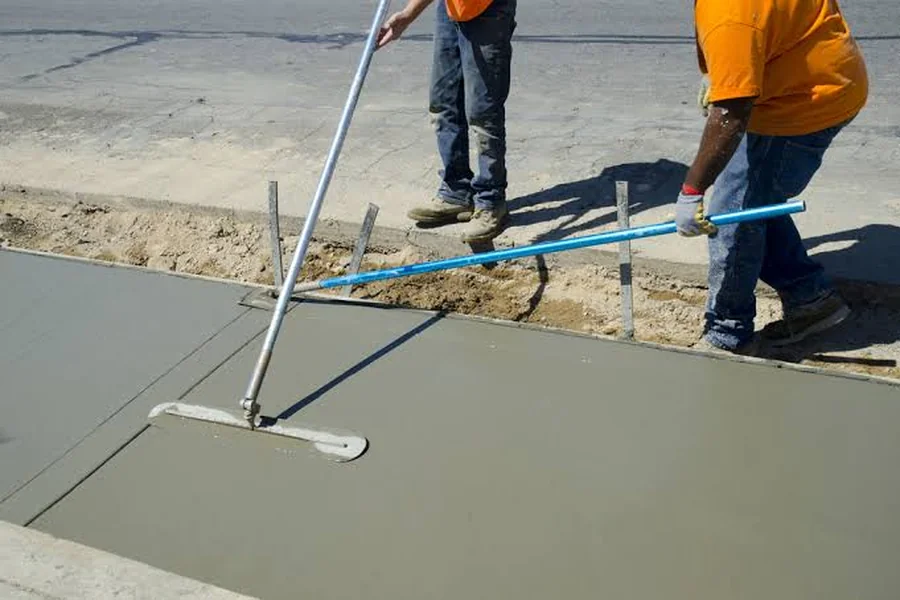
Concrete is unusual among finished surfaces in that a significant share of its final appearance is determined during the first month of its life, long before the space looks anything like a room.
Curing Decides The Color
Concrete does not dry. It hydrates, in a chemical reaction that continues for weeks and needs water present to proceed.
Where moisture leaves the surface faster in one area than another, the reaction proceeds at different rates in those areas, and the result is visible as shade variation once the floor is polished or sealed. Anything sitting on the slab changes the local rate of moisture loss, which is why the marks so often reproduce the shape of the object that made them.
Plastic sheeting laid in overlapping strips is the classic cause. Under the sheeting, moisture is retained. At the overlaps, more so. Along the open edges, less. The finished floor carries a record of exactly where those edges were, and the industry name for it is curing lines.
Sunlight through window openings does the same thing at a larger scale, warming and drying part of a slab while the rest stays cool.
The practical point is that uniform conditions across the whole slab matter more than any particular condition. A floor that cures slightly slowly but evenly looks better than one that cures at the correct rate in patches.
Porosity Is The Second Problem
Uncured and unsealed concrete is porous, and it absorbs whatever lands on it.
Oil from plant and equipment penetrates rather than sitting on top. So does coffee, so do adhesives, and so do the solvents used to clean them up. Rust staining from rebar offcuts or steel stock left on a slab overnight goes deep enough that surface grinding may not reach it.
Tannin from timber is the one that surprises people. Lumber stacked on a damp slab leaches tannins into the surface and leaves brown marks in the shape of the stack.
The common factor is that these are absorption problems rather than deposit problems. Wiping them up promptly helps and does not undo them, because part of the material has already gone into the surface.
Mechanical Damage Concentrates At The Edges
Traffic across the field of a slab produces wear. Damage that requires actual repair tends to happen at edges, corners, stair nosings, and column bases.
Those are the points that take impact from carts, pallet trucks, scaffold being moved, and material being set down. They are also the areas most likely to be missed when protection is laid, because flat coverage is easy and vertical or transitional coverage is fiddly.
A stair tread with a chipped nosing, or a column base scuffed to the aggregate, is a repair that shows afterward regardless of how well it is done.
Three Different Jobs, Three Different Products
Choosing concrete floor protection during construction means matching the method to the exposure, and the exposure varies across a single building.
Peelable adhered systems bond to the slab, typically as a liquid base coat with matting pressed into it. Because they adhere, debris cannot migrate underneath, and because they cover the full area continuously, they give even curing conditions and no curing lines. They suit large areas exposed for long periods, and they are usually rated for around twelve months.
Rigid boards handle impact and point loading, which adhered systems do not. Under work stations, in forklift routes, and anywhere heavy material gets set down, board is the answer.
Loose-lay mats are the quick option for shorter exposure on already-finished surfaces. They install and lift fast, and they move, which means they need attention if they are covering something valuable.
Most projects need more than one of these, and the usual error is picking one and applying it everywhere.
The Cure Window Constrains The Schedule
Protection cannot go down on fresh concrete immediately.
New slabs have high surface alkalinity, and coatings applied before the pH has dropped can react with the surface. The common guidance is a wait of roughly two to four weeks depending on thickness and conditions, and the same applies to any densifier, sealer, or coating already on the floor, each of which needs to reach its own manufacturer’s cure before anything is laid over it.
That leaves a gap between placement and protection, which is exactly the period when curing conditions matter most. Purpose-made curing compounds address it by forming a subsurface moisture barrier that supports even hydration and then dissipates, leaving nothing to remove and nothing to interfere with a later coating.
The sequencing question is worth settling at programming stage rather than discovering on site that the floor needs protecting three weeks before it is allowed to be protected.
Coverage Is The Part That Gets Underestimated
Whatever product is chosen, the quantity estimate tends to run short.
Adhered systems consume more base coat on rough or textured surfaces than on smooth ones, and considerably more across saw cuts and control joints. Ordering against the flat-floor yield figure means a second delivery partway through the job.
Vertical and transitional elements need their own products. Stair treads, corners, and column bases are not covered by area calculations based on floor plan, and they are where the expensive damage happens.
Removal deserves a thought too. Adhered systems peel off in strips, and peelability degrades with prolonged UV exposure and with freezing conditions. An area left exposed to sun for longer than planned removes harder than one that was not.
Four Things To Fix Early
When the slab is placed, and how it will be kept at uniform moisture before protection can go down.
Which areas take traffic and impact rather than just foot traffic, since those need board rather than film.
What the protection is going over, checked against the product’s compatibility list, and tested on the actual substrate.
Who is removing it, when, and whether it will have been in sunlight or frost for longer than the product allows.
The marks that show up at handover are made months earlier by people doing nothing wrong. They are just made on a surface that was still deciding what it was going to look like.
